Short answer: Being locked out feels like an emergency, but for a trained locksmith most residential lockouts are a quick, non-destructive job. Here's what actually happens at the door, when drilling is genuinely justified, and why the phrase "we have to drill it" should make you slow down and ask questions.
Being locked out feels like an emergency, but for a trained locksmith most residential lockouts are a quick, non-destructive job. Here's what actually happens at the door, when drilling is genuinely justified, and why the phrase "we have to drill it" should make you slow down and ask questions.
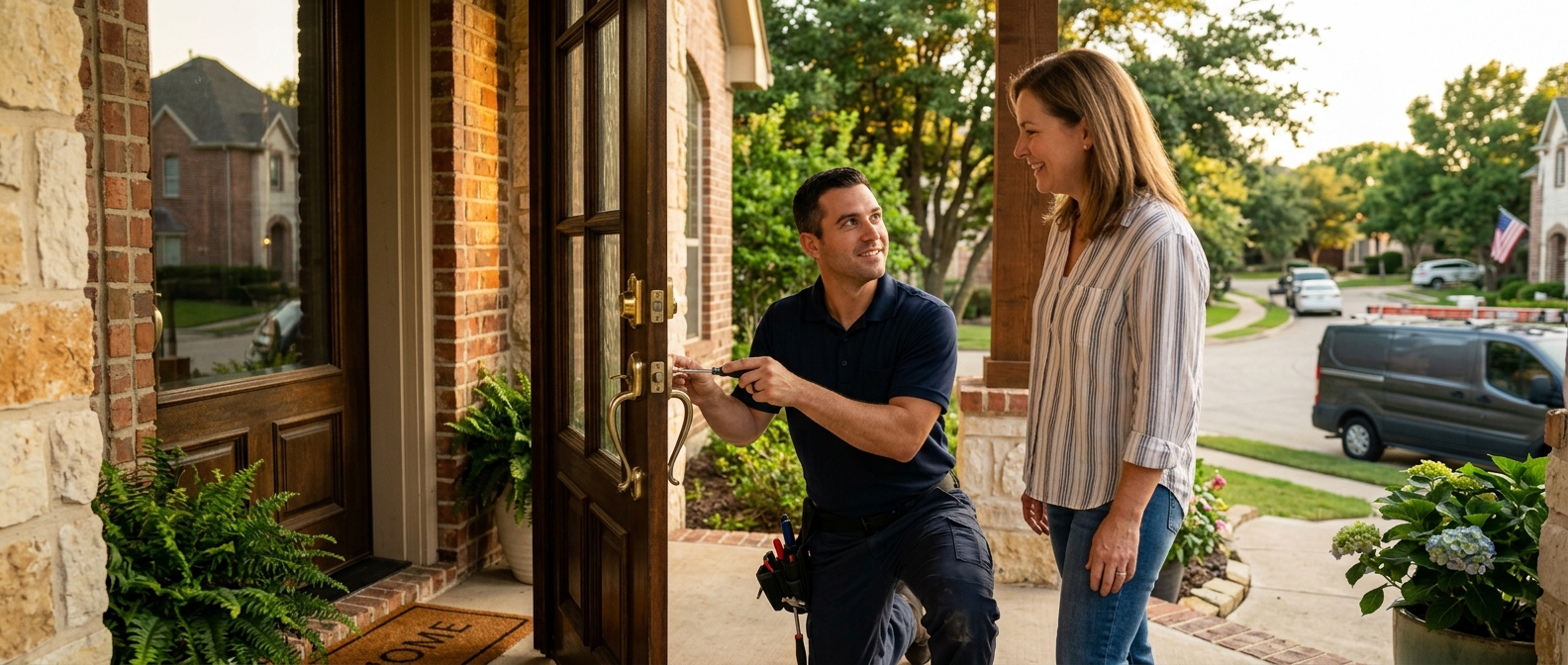
For a trained locksmith, the average house lockout is a quiet, tool-in-hand job that leaves no trace. Standard residential locks are built to be serviced, and the same features that let a pro work on them let a pro open them. On a spring-latch door, a thin shim can slip the angled latch back in seconds. On a deadbolt, single-pin picking sets the pins one at a time until the cylinder turns, exactly the way your key would. Where there's a gap at the top of the door, an under-door tool can reach in and work the interior thumb-turn. None of this harms the lock, and you keep using the same key afterward, which is the whole point of hiring someone who knows what they're doing.
Drilling does have its place. A genuine high-security cylinder built to resist picking, a mechanism that's already seized or broken, or a lock you were planning to replace anyway can all justify it. What should give you pause is a technician who pulls out a drill within a couple of minutes on an ordinary knob or deadbolt, or who claims flatly that all deadbolts have to be drilled. They don't. Drilling destroys the cylinder and conveniently sets up the sale of a replacement, which is exactly why it's a favorite move of scam operators. It is completely fair to ask a tech to attempt non-destructive entry first, and to explain, if they can't, why drilling is genuinely necessary.
A little diligence before anyone drives out can sometimes save you a service call entirely. Walk the house first. A back door, a garage entry keypad, or an unlatched window is open more often than you'd guess. Confirm you're truly locked out and not fighting a lock that's actually failing. When you do call, ask for an all-in price including any trip or after-hours fee before they dispatch. And don't be thrown when a reputable locksmith asks you to show ID or proof you live there once they arrive; that's them protecting you and the property, and it's a reassuring sign rather than a hassle. For a straightforward daytime residential lockout, expect something in the $75 to $150 range, with after-hours and high-security work costing more. Use that only as a ballpark to weigh any quote against.
For a trained locksmith, the average house lockout is a quiet, tool-in-hand job that leaves no trace. Standard residential locks are built to be serviced, and the same features that let a pro work on them let a pro open them. On a spring-latch door, a thin shim can slip the angled latch back in seconds. On a deadbolt, single-pin picking sets the pins one at a time until the cylinder turns, exactly the way your key would. Where there's a gap at the top of the door, an under-door tool can reach in and work the interior thumb-turn. None of this harms the lock, and you keep using the same key afterward, which is the whole point of hiring someone who knows what they're doing.
Drilling does have its place. A genuine high-security cylinder built to resist picking, a mechanism that's already seized or broken, or a lock you were planning to replace anyway can all justify it. What should give you pause is a technician who pulls out a drill within a couple of minutes on an ordinary knob or deadbolt, or who claims flatly that all deadbolts have to be drilled. They don't. Drilling destroys the cylinder and conveniently sets up the sale of a replacement, which is exactly why it's a favorite move of scam operators. It is completely fair to ask a tech to attempt non-destructive entry first, and to explain, if they can't, why drilling is genuinely necessary.
A little diligence before anyone drives out can sometimes save you a service call entirely. Walk the house first. A back door, a garage entry keypad, or an unlatched window is open more often than you'd guess. Confirm you're truly locked out and not fighting a lock that's actually failing. When you do call, ask for an all-in price including any trip or after-hours fee before they dispatch. And don't be thrown when a reputable locksmith asks you to show ID or proof you live there once they arrive; that's them protecting you and the property, and it's a reassuring sign rather than a hassle. For a straightforward daytime residential lockout, expect something in the $75 to $150 range, with after-hours and high-security work costing more. Use that only as a ballpark to weigh any quote against.
Call (469) 607-2770 and describe the situation, your exact location, and what you need. Timing is confirmed on that call rather than promised in advance.
Call for help: (469) 607-2770 — a straight answer and an honest estimate before any work begins.